


Subscription invoicing in Hungary: what to check
A recurring payment and an invoice are not the same record. For a Hungarian subscription service, establish the applicable settlement period, invoice timing, tax treatment and NAV reporting duties before you automate the workflow. The VAT Act (§ 58) covers periodic settlement; the rules themselves are for your accountant to apply.
Jurisdiction: Hungary · Last reviewed: 22 October 2026
This guide is general information, not tax or legal advice. Requirements can vary by transaction and applicable jurisdiction.
Define the settlement period
Write down the period each charge covers, whether the price can change mid-period, and what happens on cancellation. These facts are what the accountant needs to assess the periodic settlement question.
Keep the payment and the invoice apart
The payment provider records the charge. The invoicing provider issues the invoice document. The two can fall on different dates, so map which system holds each record.
Confirm invoice timing with your provider
Ask your invoicing provider when an invoice is created for each charge, how a correction is made, and who sends the invoice data to NAV.
Take the examples to an accountant
Official sources set the rules. Komashi applies the tax treatment you configure, and your accountant decides the treatment and the reporting duties for your company.
A walkthrough to take to your accountant
Hypothetical example, not a recommendation: a Hungarian company subscribes to Care Plus at $190 per month, billed on the same day each month. Walk through the first charge, one plan change in the middle of a period and one failed payment. For each, note which record is created, by which system and on which date, then ask the accountant which VAT and reporting treatment applies.
What Komashi does, what the provider does, what the accountant decides
What Komashi does
- Stores the price and billing period for each subscription.
- Sends each charge through the payment provider you connect.
- Requests the invoice from the invoicing provider you configure.
What the invoicing provider does
- Issues the invoice document in its own system.
- Handles NAV reporting as its own service describes it.
- Explains how corrections and cancellations are issued.
What the accountant decides
- Whether the periodic settlement rules apply to the arrangement.
- The performance date and VAT treatment of each charge.
- Which correction and reporting steps the company must take.
Check the transaction against official Hungarian sources
Use these sources to prepare questions. Confirm your invoicing and data-reporting obligations with a qualified accountant.
- Áfa tv. (Act CXXVII of 2007), § 58: periodic settlement (opens in a new tab) Hungarian legal database. Version in force 15 September to 31 December 2026, checked 22 October 2026.
- NAV: Periodic settlement transactions (opens in a new tab) NAV leaflet created in December 2015 on the rule applying from 1 January 2016. A historical explainer; check the current law.
- NAV: Using the Online Invoice system (opens in a new tab) Page dated 3 August 2024, checked 22 October 2026.
How Komashi fits
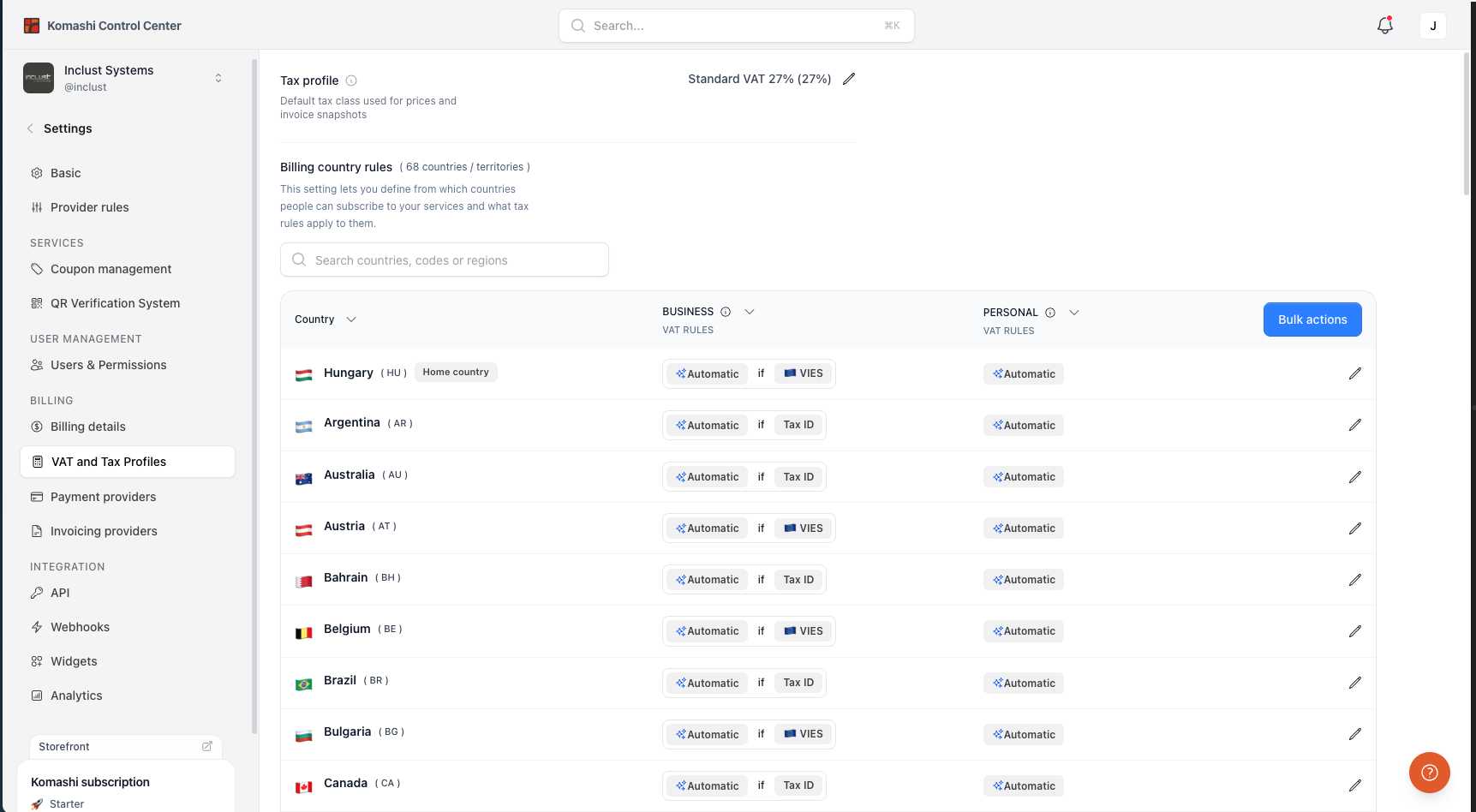
Komashi connects to the invoicing providers Billingo and Számlázz.hu where you configure them, and the provider issues the invoice document. Komashi does not decide your invoicing or reporting obligations.
See payments and invoicingWhat to check before you launch
- The settlement period, mid-period price changes and cancellation rule are written down.
- Each record (charge, invoice, NAV report) has one named owner in your workflow.
- Your invoicing provider has confirmed when an invoice is created and how corrections are made.
- Your accountant has reviewed the walkthrough, including the § 58 and NAV reporting questions.
Ready to put this into practice?
Create a service with Komashi.