


EU VAT for recurring services: what determines the treatment?
The VAT treatment of a recurring service depends on facts: what you supply, whether the customer is a business or a consumer, where each party is located and how the service is delivered. Komashi applies the tax settings you configure; it does not decide your VAT treatment. Use the facts below to prepare for an adviser.
Jurisdiction: European Union · Last reviewed: 22 October 2026
This guide is general information, not tax or legal advice. Requirements can vary by transaction and applicable jurisdiction.
Assemble the facts before asking
Describe the service, customer type, relevant locations and delivery model. A qualified adviser can use those facts to assess which rules may apply; a generic checklist cannot determine the result.
Separate operations from tax judgment
Your systems can record customer and service details and coordinate invoicing, but they do not independently determine the correct VAT treatment. Ask a professional what evidence and records are relevant.
Use current official sources
Check current European Commission and relevant national tax authority materials, then ask a qualified adviser how they apply to your circumstances. Cross-border services and changing rules make old summaries unreliable.
Coordinate the approved workflow
After professional review, configure how staff and invoicing tools reflect the agreed process. Revisit the advice when the service, customer mix, locations or relevant rules change.
Facts to gather before the VAT question
- What the service is and how it is delivered, including any contract changes during the term.
- Whether the customer is a business with a VAT number, or a private customer.
- Where you are established, and where the customer is established or usually resident.
- Which records show the customer’s status and location.
- Whether any registration, scheme or return may apply to the supply. Ask an adviser.
A hypothetical example with two customers
Hypothetical, no amounts, not a VAT ruling
Business customer
A company in another EU country buys a monthly service and gives its VAT number. Question for the adviser: which place-of-taxation rule applies, and what should the invoice and customer record show?
Private customer
A private person in another EU country buys the same service. Question for the adviser: does a One Stop Shop scheme apply to this supply, and how is the rate decided?
Komashi configuration and legal responsibility
What Komashi does
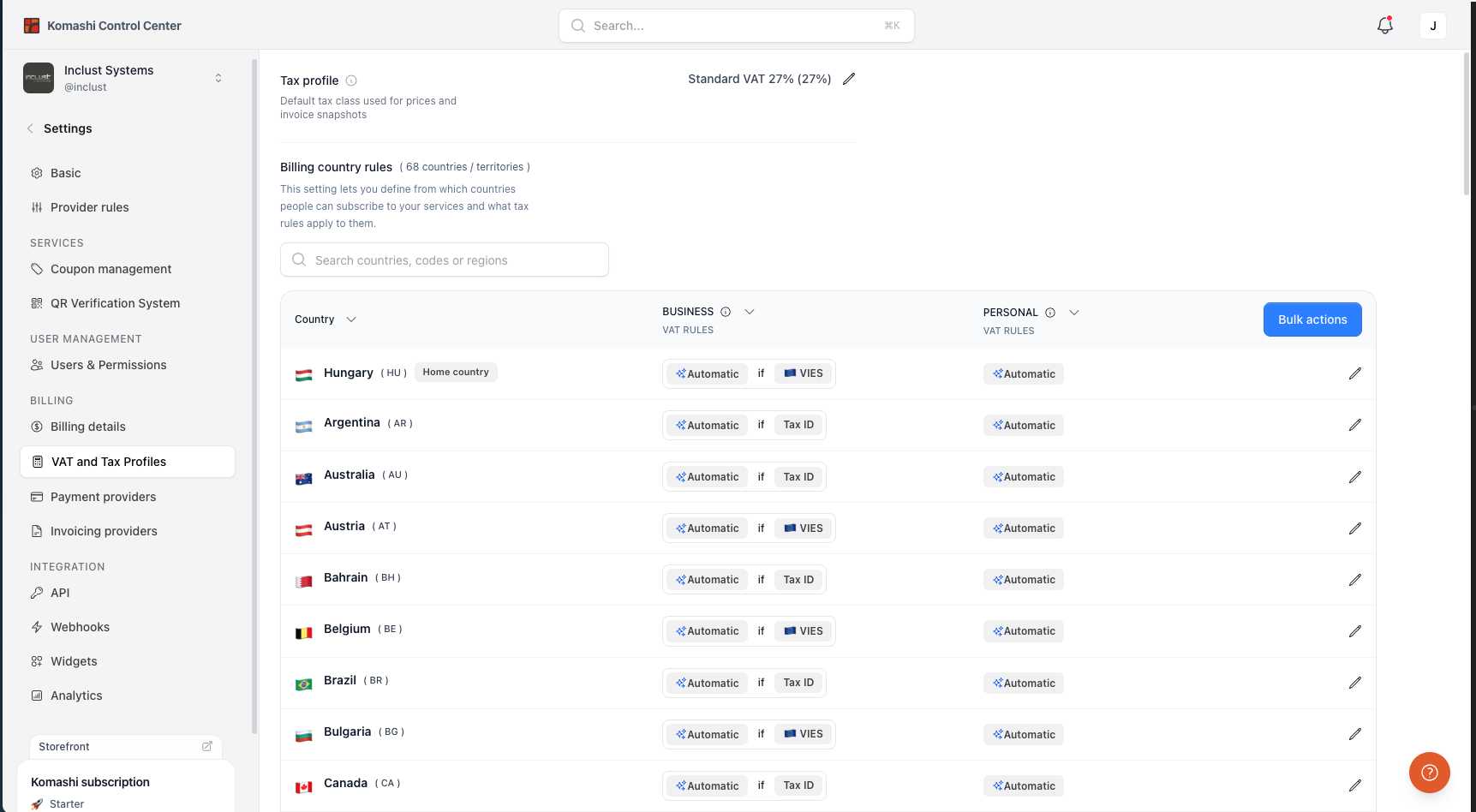
- Applies the tax treatment you configure for supported countries at checkout.
- Keeps tax information connected to orders and invoices.
What you and your adviser decide
- The VAT treatment for each customer type and location.
- Whether any registration, scheme or return applies, and how it is filed.
- The settings you enter in Komashi, which must match the advice you receive.
Start with current official guidance
These sources help frame the questions; they do not determine the VAT treatment of your service. The Commission pages show no update date.
- European Commission: Place of taxation (opens in a new tab) Covers where VAT is due, including services. No update date shown; checked 22 October 2026.
- European Commission: Taxable transactions (opens in a new tab) Covers the four types of taxable transaction. No update date shown; checked 22 October 2026.
- European Commission: VAT e-Commerce One Stop Shop (opens in a new tab) Cross-border business-to-consumer supplies, including services, since 1 July 2021. No update date shown; checked 22 October 2026.
How Komashi fits
Komashi applies the tax settings you configure for supported countries at checkout and keeps tax information connected to orders and invoices. It does not determine your VAT treatment, register you or file returns.
Learn about Komashi Tax EngineWhat to check before you launch
- Describe the service, the customer type, the relevant locations and the delivery model.
- Ask your adviser which evidence and records are relevant.
- Ask which registrations or schemes apply to you.
- Revisit the advice when the service, customer mix, locations or rules change.
Ready to put this into practice?
Create a service with Komashi.