


What is VAT ID validation?
A check on whether a business customer's EU VAT number is valid. The tax treatment of the sale can depend on the result.
Short answer
VAT ID validation is checking a business customer's VAT identification number against an official register. In the EU that register is VIES, run by the European Commission. A valid result is one input to the VAT treatment of a cross-border business sale. It does not decide that treatment on its own.
How it works
The seller enters the customer's VAT number with its country code, and the number is checked in VIES. The answer is valid, invalid or a temporary failure. A valid answer is one condition for treating a cross-border B2B sale under the reverse charge; the other conditions come from the VAT rules that apply.
Illustrative example
Hypothetical: a Dutch company buys a service from a Hungarian provider. The VAT number is checked in VIES and returns valid, and the date of the check is recorded with the customer. The adviser then confirms the VAT treatment for that sale.
Common confusion
A valid VAT number is not a confirmed tax treatment. It shows the number is registered. It does not show the purchase is for business use, where the supply takes place, or that either party has reported correctly.
How Komashi handles it
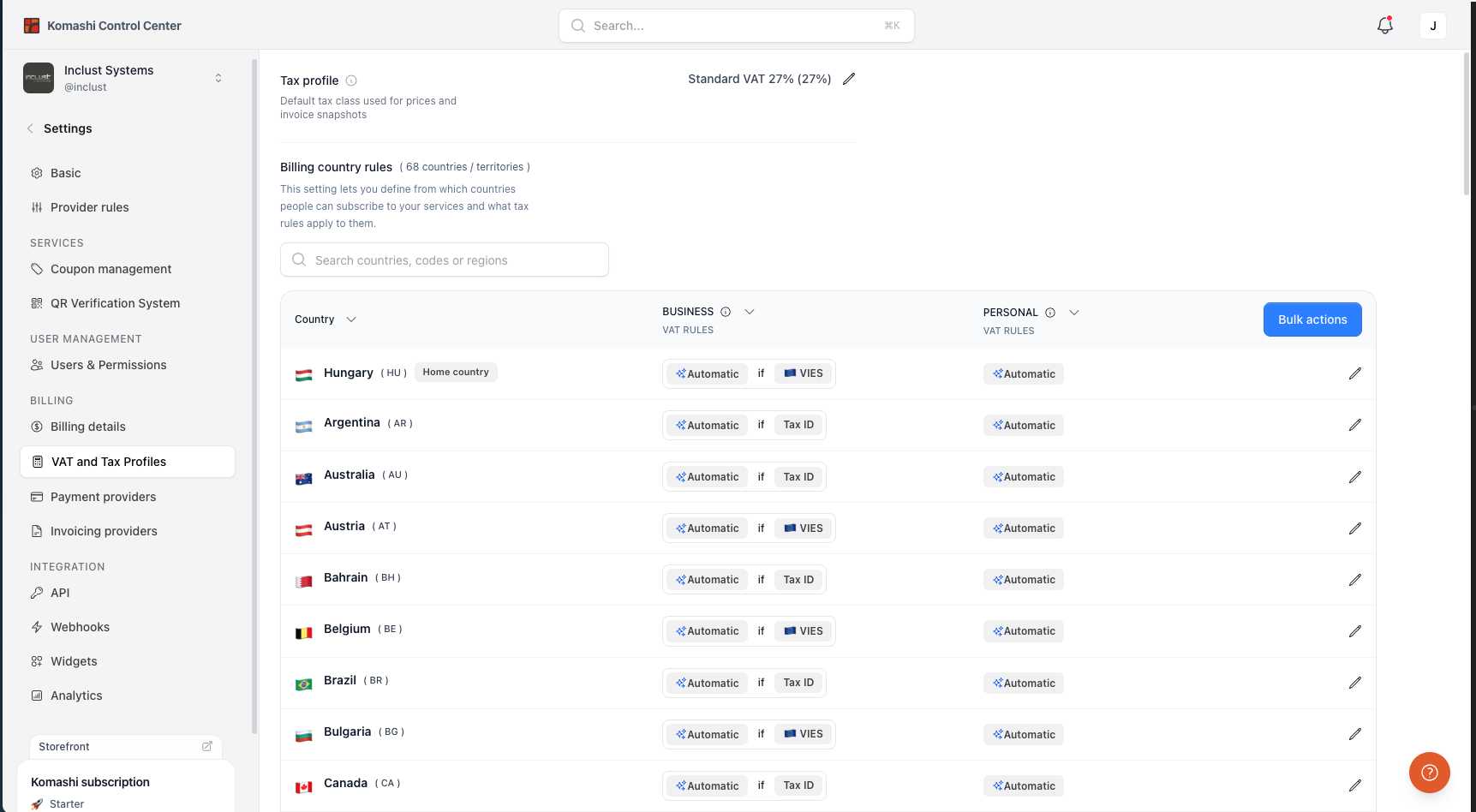
When a customer's billing details are saved, Komashi checks an EU business VAT number with the VIES service. A valid result is kept for 90 days and is used for checkout tax decisions. Invalid results do not qualify for the business tax branch, and a failed check records a retry time. Non-EU business customers are not checked in VIES. If the provider and the customer are in different EU countries and the VIES result is valid, checkout applies the zero-tax reverse-charge scenario and labels it on the record. Komashi does not file VAT returns.
Official sources
Check the current text of these sources before you rely on a rule for a specific transaction.
Common questions
What does a valid VIES result prove?
It shows the VAT number was registered in VIES at the time of the check. It does not confirm the tax treatment of a particular sale, which depends on the rules that apply.
What happens when VIES is unavailable?
The number cannot be confirmed, so the business tax branch is not used for that customer until a valid result is recorded. Komashi keeps the failed attempt and a retry time.