


What is recurring billing?
The charge that repeats on a schedule for as long as the customer stays on the service.
Short answer
Recurring billing means charging a customer again for the same ongoing service on a fixed schedule, such as every month or every year. The agreement stays in place until it is changed or ended, and each charge is a new billing event.
How it works
A billing period starts, the customer is charged the agreed amount, and the record shows that period as paid, pending or failed. The next period starts at the renewal date. A change to the price or plan takes effect either straight away or at the next renewal, depending on how the agreement is set up.
Illustrative example
Hypothetical values, not a price list: a service at $190 a month that renews on the 1st. Each month produces one charge of $190. A one-time setup fee, if there is one, appears only on the first invoice.
Common confusion
Recurring billing is not the same as recurring payments. Billing decides when and how much is due. Payments are how the money moves, and a failed payment is a separate event that needs its own follow-up.
How Komashi handles it
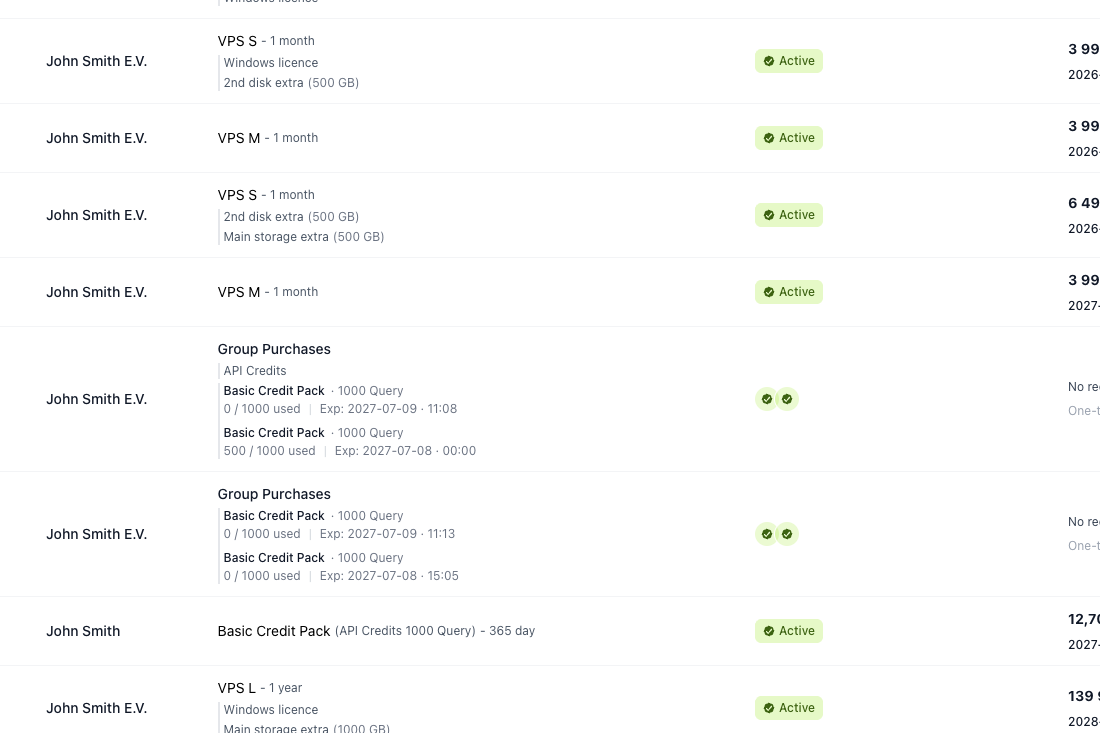
Komashi keeps the billing schedule for each subscription, with the amount and payment state of every period. Customers see the recurring total and any one-time charges before they pay. Payments run through the payment provider you connect.
Common questions
Is recurring billing the same as a subscription?
Not quite. A subscription is the ongoing agreement with the customer. Recurring billing is the repeated charge that follows from it. A subscription also covers plan changes, renewal and cancellation.
Does the recurring amount have to be fixed?
No. It can be a fixed amount per plan or a price that varies with usage or add-ons. Whatever it is, the amount for each period should be visible before the customer agrees.