

How to use AI to draft — and verify — service pricing
How to get a usable plan and price draft from AI for a recurring service, and what to check before it reaches your customers.
At a glance
AI can quickly draft a plan with a name, contents, exclusions and a starting price, but it does not know your costs, your capacity or your customers. Use it for the first draft, then check four things: what you promise, the price against your own costs, one-time and recurring items, and whether a buyer would understand it.
This guide is for service providers who want AI to draft the first plans and prices for a new recurring service, but do not want to put an unchecked price in front of customers.
An AI suggestion looks convincing: it has a name, contents and a round price. The problem is that the price does not come from your costs, and the contents may promise things you cannot deliver. AI gives you a good first draft – the decision stays with you.
1. Give a precise description
The more specific the description, the less you need to fix. Instead of a general request (“create IT support plans”), say who it is for, what is included and what is not:
I provide remote IT support to offices of 5–15 people. It includes weekday help, a monthly device check and a monthly report. On-site visits are not included. I want a monthly subscription and a one-time onboarding fee. Suggest a plan name, exact contents, exclusions, a billing period and a starting price. Mark anything you do not know separately.
2. Check what you promise
Look at the response times, availability and reporting the draft promises. Remove anything you cannot deliver over time. If the draft’s three plans barely differ, one well-defined plan is enough.
3. Calculate the price from your own costs
The AI’s starting price does not know what an hour costs you. Calculate your monthly cost, then the price: price = monthly cost ÷ (1 – target margin). The full method is in the guide to pricing recurring services.
4. Check one-time and recurring items
Every amount should show its billing period. Setup is one-time and should not renew monthly; a monthly add-on is recurring and should not appear as a one-time item. For an annual discount, use the pricing calculator to see how much margin is left.
5. Read it as a buyer would
Is it clear what the plan includes, what is due now, what the renewal amount is and what costs extra? Replace placeholder text, and remove any claim you cannot back up.
Remote IT support – an example
Example: for the description above, the AI suggests an “Office Support” plan at $190 a month. The provider calculates their own cost:
| Cost | Assumption | Monthly |
|---|---|---|
| Support | 2 hours × $70 | $140 |
| Software and monitoring | fixed | $30 |
| Overhead | share per customer | $20 |
| Reserve | unexpected requests | $30 |
| Total | $220 |
- The AI’s price: $190 – a loss of $30 a month per customer.
- At a 30% target margin: $220 ÷ 0.70 = $314.29, rounded to $315 a month (about 30.2% margin).
- If that is too high for the market: fewer included hours or narrower contents are needed, not a lower price for the same work.
The numbers are assumptions; use your own.
How to set this up with Komashi
Komashi AI suggests a service description, plans, exclusions and starting prices from your description. The suggestion is a draft: you can review and edit it, and it is only saved after you approve it. In the service editor you then set the billing periods, one-time items and add-ons.
Komashi AI does not check competitors’ prices, does not know your costs, and does not guarantee demand or profit – checking the price is up to you.
Checklist
- Your description says who it is for, what is included and what is not.
- You can deliver every promise over time.
- You calculated the price from your own monthly cost.
- One-time and recurring items are set up correctly.
- No placeholder text or unsupported claims remain.
Next step
See how Komashi AI works, or read how to turn a service into a recurring plan.
Sources and further reading
Updated:
More articles
How to price a recurring service without guessing
A formula and a worked example for pricing a recurring service: monthly cost, target margin, one-time fees, and what an annual discount does to your margin.
How to turn a service into a subscription package
Does a subscription suit your service, and what do you need to decide before making it a monthly plan – the need, scope, capacity, price and customer journey.
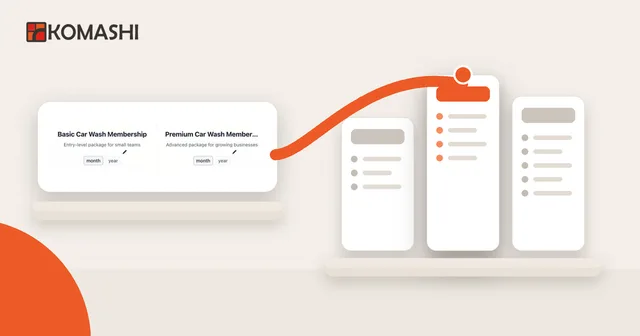
Subscription pricing models: design three clear service plans
Subscription pricing for service businesses: what should separate three plans, how to price each tier from its cost, and how to fit it on one offer sheet.